Black bean salad to replenish your magnesium!

Black beans are very rich in magnesium, a very beneficial mineral and they make a delicious warm salad in about five minutes. It is a wonderful menu item on a day when you are home-bound by a snow blizzard as you don’t really need to get to the grocery store to gather ingredients.

Black Bean salad as garnish to Roast Duck with turnips

For two large portions, almost meal size, I drained and rinsed a can of black beans. Then I sauteed half a sliced onion with olive oil in a frying pan with a diced pepper. Any colour or a mix will work equally well. After about 3 minutes on medium/high heat and constant stirring, add the beans for another 2 minutes on medium and stop stirring. The black bean will get mushy quickly, so wait until you are ready to eat to add them. Before turning the heat off add one tbsp Dijon, three tbsps cider vinegar or lemon juice or lime juice and sprinkle with cilantro or parsley. Salt to taste, remembering that canned beans are usually pretty salty.

Black beans contain 120 mg of magnesium per cup. Refer to the WHFoods newsletter for the nutrition benefice of eating black beans.

Rinsing the canned beans  is highly recommended as it makes them much crispier but also reduces the flatulence effects and removes some of the “bad carbs”.

Posted in Lunch, Side, Vegetarian | Tagged , , , , , , | Leave a comment

The Cooking Frog’s blog reviewed

From the Hampshire Cook:

I follow the Cooking Frog’s Blog, authored by a French woman on Vancouver Island, and was laughing out loud recently at her amusing piece on having to fly all the way back to Aix-en-Provence to find a rabbit to cook her favourite roast rabbit with Dijon mustard.  Canadians surely must have been grateful for rabbit meat at some point in the development of their nation, though  apparently now they are appalled at the very idea of eating Bugs Bunny.  And her stuck-up Canadian butcher kind of scoffed at her when she asked if they stocked such a thing.

What I like about her blog–other than the particular slant of her humour–is that she talks/writes her way through making a dish, often with no lists of ingredients, no precise measurements and scant methodology–such a simple and confident way to present what you are cooking in your life.  She blogs about normal family French cooking, the food of her.  And the pix are what please her, a skinned rabbit on a plate for example.

It pleases me too. We need no more than she offers to be engaged and feel that we could easily replicate her food.  I admire too her quiet authority and the sense of a deep history of good cooking.

I could not have said this better myself! Thank you Hampshire Cook!

PS: For my Victoria friend, I swear that the Hampshire Cook had no information whatsoever about the years of debate on what to do with the University of Victoria rabbit population. She is right, most Canadians are no longer wilderness pioneers, red-neck cow-boys, nor adventurous explorers. But I will do all I can to save them from processed food.

Posted in Stuff | Tagged , , , , , | 2 Comments

Halloween Squash or Pumpkin au Gratin

Last year the blog featured something scary for Halloween, but scary is no longer politically correct, so this year I have something orange. Not that I pay attention to correctness when it comes to cooking, but last year’s post, you would not have wanted to eat, cook or even see. So there is something creamy and soft that will go smoothly on Hallow’s eve.

It is best not to use regular pumpkin as their meat barely has any taste, but otherwise you can mix any kind of squash. For the bright orange colour, you are best to include orange hubbard squash or at least kabocha, more yellow. However, the very best choice is: The Pumpkin French Cinderella, ‘Cucurbita maxima’,  a beautiful French antique heirloom with vibrant mahogany-orange skin that transformed into a coach for Cinderella. The French Cinderella is also called Rouge Vif D’étampes.

The quantities are not very important for this. For four, you need  about the equivalent of 6 cups of diced squash. First, peel the squash and remove all the seeds. Best to use a Y shaped potato peeler and to wear rubber gloves for that. Then dice the pieces. Cook in olive oil with 2 peeled apples (any variety) , a clove garlic, thyme and salt,  for 20 minutes.

Mash with a food mill or a fork and add  one beaten egg, about 1/2 cup hot whole milk, sour cream, 10% or  heavy cream. Basically you choose how much you want to indulge with the cream! You must however add one cup of grated Gruyère or Swiss cheese. Bake in the oven for 20 minutes on 340. You may add lardons and garlic croutons, but on Halloween, I opted for blue corn chips, just because. 


Posted in Vegetables, Vegetarian | Tagged , , , , , , , , | 1 Comment

Cream or not Cream of Wild Mushroom Soup

Saturday, I picked wild white chanterelles in the pouring rain and tonight the forecast is warning against frost. The Indian Fall is not that hot this year and I am making mushroom soup to warm up. The best way to clean the chanterelles is to keep them dry and to use a knife to trim the stem and  scrape off the moss, pine needles and soil, then wipe the knife and repeat.

Chanterelle Soup

First thing is to melt one slice of thick  double-smoked bacon in a Le Creuset pot. Add about 2 cups of chanterelles cut up in small pieces (just tear them apart with your fingers, they actually shred), 1 cup of cut up white mushroom,  one  sliced  medium onion, 1 clove garlic,  and 1/2 cup celery leaves if available. Sauté until the onion is transparent about 5 minutes. Add 1 liter (about 4 cups) of chicken broth and 1/4 cup of  chopped parsley. Simmer for 30 minutes with a lid on.

A whole celery with the root, stems and leaves

Finish by pulsing in the blender or in the food processor with 1/4 cup sour cream or regular cream or no cream at all, not to fine, you want to see small pieces of bacon and mushroom. Serve with parsley leaves and a whole chanterelle in the centre of the bowl. Croutons optional. A glass of red wine or white wine are also optional as a replacement for 1 cup of broth.

I got lost in the woods  searching for chanterelles and ended walking somewhat in circles, but mostly up and down, probably  ten kilometers in diluvian rain, carrying two heavy baskets of chanterelles  without any chocolate in my pocket or anything else to eat.  I had never tasted  anything so good as the cauliflower cake  made by my friend Sharon from Yotam Ottolenghi’s recipe published in the Guardian when I finally reached the trailhead.

Posted in Soup | Tagged , , , , , , , | 4 Comments

Icelandic Minke Whale Steak

Minke whale are not endangered  and they rather flourish in Icelandic waters with counts over  70000 just in that area. Being quite a delicacy, no wonder that they have been a staple on Icelandic menus for centuries. The meat  (Minke are mammals, not fish) is very red like a Toro tuna with a texture like the most tender beef filet mignon you ever tried. It is for sale in most butcher shops in Iceland and at the Airport duty-free counter, pre-packaged either as small marinated filet or as a whole plain filet. I was lucky to be on the way to France when my eye caught the  Icelandic only labels. As there was no border control to prevent the export from Iceland or the import in the E.U., there I was, proud owner of the rare treat  while staying at my sister in the Alps for a few days.

Marinated Minke filets

It was not too hard to convince Christophe, my brother-in-law and also a Master Carpenter to use some of his best hardwood scraps to light the perfect barbecue. The whale needs very high heat and very little time. It is best served quite rare like tuna, hardly 2 minutes on each side. 

The tasting provided excellent results, I preferred the marinated chunks but the plain thick steak was also praised. Both are well worth getting if you are on your way to Europe.

Steak cut

I have compiled some information about the nutritional values of Minke meat  from Taneko Suzuki, Professor, Nihon University:

Whale Meat Is Rich in High-Quality Protein. It has a Lower Calorie Content Than Beef or Pork, a Much Higher Iron Content Than Other Animal-Related Foodstuffs,  Is Rich in Polyunsaturated Fatty Acids,  Is Relatively Low in Cholesterol and the leanest meat.

Duty-free sealed package at Reykjavik airport

Posted in Main Course | Tagged , , , , , , , | 3 Comments

Lapin à la Moutarde de Dijon

This recipe is a family staple that I have wanted to feature for a long time. The delay was caused by the extreme difficulty that faced me trying to assemble the ingredients. A little bit of cream is no problem, even a little white wine can be found in Canada if you don’t mind going to a Government store to purchase the “criminal” nectar, the Dijon mustard is ready available almost anywhere. But, the lapin? Hordes of them have been taunting me on the University of Victoria campus and in my own backyard fighting for my best bushes with the deer. But, even expressing the thought of eating them would bring outrage. Can’t really risk a charge of cruelty to Bugs Bunny.

So here I am visiting my brother in Aix-en-Provence and my chance to buy a nice big specimen without further question or anyone raising an eyebrow. When I had gone to the Oak Bay Butcher Shop, a place that sees itself as a serious butcher, and asked for a rabbit, the two staff behind the counter had acted as if I was pulling an April’s fool prank on them sending me on my way with that arrogance often described as French in North America and absolutely no rabbit.

After first coat of Dijon, add another one after browning

The rabbit is painted with a thick coat of Dijon Mustard and sprinkled with a tbsp of olive oil, browned on high for 10 minutes, turned over and browned on the other side for 10 minutes, then roasted another 25/30 minutes on medium/high. Then, deglaze the pan with a glass of white wine, pour into a pot. Place the rabbit back in the oven to keep warm. Make the sauce with the  jus, 2 tbsps cream, 2 tbsps mustard and fresh thyme.

Another way to prepare this dish is to cut the rabbit first, brown the portion size pieces in olive oil in a Le Creuset dutch oven and to simmer with lots of Dijon Mustard, adding white wine, cream and thyme at the end.

Fresh Dijon Mustard


Posted in Main Course | Tagged , , , , | 5 Comments

Stuff the pork loin to take on a picnic!

I don’t know what got into me when I offered to give a pound of chanterelles to all the friends who would help me with a pledge for The Run For The Cure, coming up October 2nd. But It is on paper and I have to honor the promise, so today  I spent two hours gallivanting  in my wool socks and hiking boots through difficult terrain at my secret spot searching through the moss for the early specimen of chanterelles, and it was hot, and the mosquitoes were biting. Thank God, Jules the Jack Russell located a few patches.  With Dunnery’s help, I hauled in 3 kg of premium chanterelles, those that have not been touched by rain and are the tastiest. Not too many of those on Vancouver Island. The secret spot is so remote that there is no food available for miles and I had to bring a decent picnic to motivate the pickers. Since this was all planned, I had roasted a stuffed loin of pork last night that I just had to slice today to eat cold in the woods.

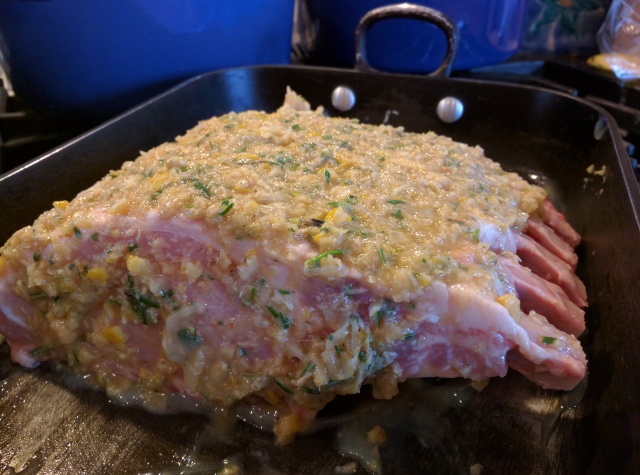
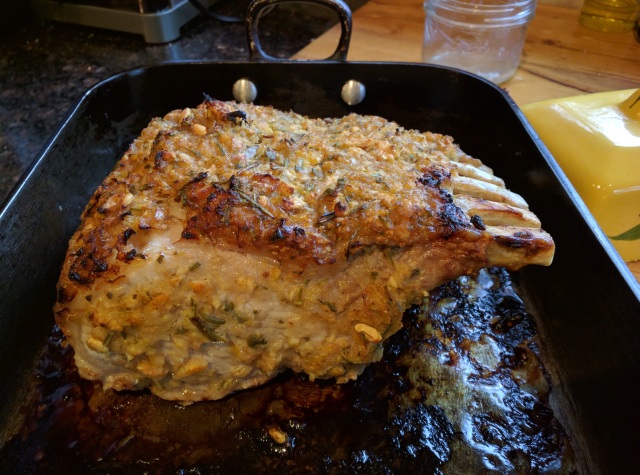
Stuffed Pork loin Roast: I started with a fairly large  loin, about 3 kg and cut it in half as I don’t own a dish long enough to roast that in one piece. I saved half and started by spreading the roast I was going to stuff on a good board, then sharpening a good knife almost like a filet knife. The key to the stuffing staying in and looking good is the cutting of the meat. So I started  by cutting through the length of the roast , not in the middle but  at about 1/3 of the thickness. You stop before cutting the roast in half, then open the top flap and keep doing further lengthwise cuts and pull open, so that the result looks like one large flat rectangle of meat. If it is not even , it does not matter. It is almost as if you were undoing a Swiss roll  jelly cake with a knife. You could not rotate the knife in the jelly groove, so you would insert and open and again.

1/2 Pork loin

All the hard work is done now, you just have to spread a filling of your choice on the meat. I used a mix of Kalamata olives, zest of half a lemon, 2 tbsp sage, 1 tbsp rosemary leaves,  2 tbsp olive oil, salt and pepper all ground together in the food processor and mixed  with 2 tbsp of hot pepper jelly. The hot pepper is nice, but next time I will replace it with grainy mustard. Also, next time, I will try stuffing with chanterelles and tomatoes, parsley and garlic.

The next trick is to roll the roast with the stuffing trapped inside. Because you are actually rolling the roast together and not just shutting it down (if you had just cut in the middle like in a butterfly cut), the stuffing does not really leak. You need twine though. Cut about 3 feet off so you do not contaminate the rest. Tie the first knot at one end of the roast but do not cut the twine, keep going like a seamstress, make the next loop and pull the thread under it before you go to do the next loop. It is neat and pretty. Decorate with a drizzle of olive oil and a sprig of rosemary, roast at 360 for 55 minutes.

Cool down, wrap and refrigerate overnight, cut thin slices the next day and eat with a dash of mustard.

And do remove the strings before serving, oops!

Thick slices to serve hot in picture or thin to serve cold.


Posted in Lunch | Tagged , , , , , , , | 2 Comments

At the Lavender Farm

A visit at the Lavender farm in Sanichton on Vancouver Island is a rejuvenating experience. The field is incredibly beautiful  with the blooming lavender plants ( of  a rich, dark, lavender colour of course) and the fragrance goes right to your head. It is immediately calming and relaxing.

Cedric and Lissa Zala normally sell the  entire crop to a wholesale outfit, but this year the man had a medical emergency just before harvest and the lavender has not vanished into a factory. This is a good alternative for the local folks as we can now buy the lavender direct from the producer.

If you get there fast, there is still a  row and a half that have not been harvested yet. Most of the crop though is hanging  upside down in bunches in the barn to air dry under the hum of the fan. When you enter in there by the side door, it is like walking into the aromatherapy room of a Provence spa.

There is a choice of three different varieties for different uses, I chose the most fragrant thinking of filling fabric sachets  for my closets and gifts. However, I was warned by Lissa that I should be careful not to use much at all of this variety in my baking as it is much stronger. The truth is, I have not made anything yet with lavender. And the other thing I have to admit is that I have not filled sachets either since my kids were young enough to want to help me with crafts. (Long time). It has been way more fun to give away the lavender bunches to my friends, and much easier. There is always next week to start sewing the sachets, when the flowers will be properly dry. Lissa also makes wreaths, wands, and other crafts to sell at the market. I am just going to try a dessert and will report on that soon.

In the meantime, if you feel like a lavender fix, take a drive to 7776 Trentelman Place in Sanichton between 6 and 8 pm.  You won’t regret it. The bunches are $5 or 5 for $20 and some of the proceeds go to charity. Then place a bunch in your bedroom and you will be guaranteed a good night sleep. Lavender has many therapeutic uses and feels good. Imagine a plant that is so good  for you!

Lissa holding 5 bunches of 2011 lavender


Posted in Little help from my friends | Tagged , , , | 4 Comments

Voodoo doughnuts earns Guinness record for biggest box

Good things come in pink boxes and the larger the box the better. The largest box of doughnut ever just earned Voodoo the Guinness record last Saturday. Of course, the box was pink! I happened to be there a few days before the record attempt and there was a long line  of people wanting  their own little pink box around the block. Like everyone else, I was told that the magic was in the hole and I had to see it for myself.

Notice the Voodoo doll doughnuts and the incredible variety. The neat fact is that they are open 24/7 and that they have a doughnut answer for any craving including  grape and bacon! The names are very creative, the colors amazing and they do taste all right. The prices are even reasonable. The owners really  have invented the magic potion, sorry I meant  magic rings.

The shop is in Portland Oregon and well worth a visit if you are in town. The decor is very “Voodoo” and  the doughnuts are incredible or at least touched by Voodoo stuff.

The irony of it all is that across the street from Voodoo there is a weird inscription on a brick wall…..

And they do keep it weird, so they do!

All photos  (except  first, last, and 2 small ones)  courtesy of Veronica Best.


Posted in Events | Tagged , , , , , , | 1 Comment

Sour Cherry Jam

Sour cherries (or griottes in French) make the best jam of all fruit, and that has got to be true because no one would  bother with the small sour cherries at all  thinking of  the work of removing the stems and pitting the cherries. Yes, it does take about an hour to pit 1.750 kg of the small sour cherry variety.  A good cherry pitter ( same tool as the olive pitter) is necessary and  so is a good show  to watch on  TV. Anyways, let’s say you manage this interminable task late at night, sprinkle the cherries (about 1.5 kg left)  with 1.250 kg of sugar and refrigerate overnight. To pit sour cherries   try pulling the pit out with the stem. If the cherries are ripe enough, it should actually slide out from the fruit, and you only need the tool as a back up.

In the old days,  the tradition was to  break the pits to find the almonds, wrap all this in a mesh bags and add it to the fruit in lieu of pectin. So go ahead with it, it works, unless you allow yourself to cut that corner and add a bag of pectin instead.

Add a lemon juice and the halves of the rind to a jam pan or your largest frying pan and slowly bring to a boil. Remove any scum (sour cherries don’t need produce much). Cook  as long as it takes for the ” is your jam ready test”. Your jam is ready if a tiny teaspoon of jam will take on a cold plate instantly. It will take some time. Cool 10 minutes, stir, remove the lemon rinds and transfer into sterilized jars. Screw the tops on and turn the jars upside down for a while (so the fruit does not all float to the top of the jar).

old fashion cherry pitter

Posted in Stuff | Tagged , , , , , , | 3 Comments

Peppers of all colours

The Bell peppers are really sweet right now. They are sweetest in July/August when they can fully  ripen before harvest. The local red, orange and yellow peppers are the sweetest of all and they also contain the most vitamin C, and lots of carotene and  the antioxidant lycopene. Like avocados, peppers are  a fruit although they are treated as a vegetable for culinary purpose. They are great just plain as a fruit cut up in slices but I like them best sautéed  with bacon!

Mix any colour peppers cut in squares into a frying pan with slices of bacon cut in four and slices of sweet onion. Sauté on fairly high heat about 5 minutes. Drain the fat. Enjoy!

I also added some fresh lamb kidneys cut in half and barbecued about 5 minutes to make it a full meal. A little thyme is lovely as well. And the juice of half a lemon adds a little tang. Do not cover or the peppers will become soft instead of crunchy.

Reminder: now is the time to make your apricot jam, the apricots are just about perfect.

Posted in Lunch, Main Course, Vegetables | Tagged , , , , , , , | 2 Comments

Rare bright red lobster looks cooked but it still lives…

By Greg Burchell (from the National Post July 06, 2011)

When a Quebec grocery store opened a shipment of lobsters, one of the crustaceans looked like it had already been boiled and was ready to eat — until it started to move.

France Dauphin, who has worked in the fish department at the Trois-Rivières IGA for seven years, said she was taken aback when she opened the shipment.

“I found it, and ‘Hey, what’s that! Is it cooked? No, it’s alive!’ ” she laughed, and said that no one at the store had ever seen a lobster like that.

It wasn’t a zombie lobster, back from the boiling pot to terrorize bib-wearing diners, just a genetic rarity — only one in 10 million lobsters get that just-cooked look on their shell naturally.

The lobster was named Youppi, after the ginger-furred mascot of the old Montreal Expos who now cheers for the Montreal Canadiens. Ms. Dauphin said the store isn’t sure where the lobster came from, but most of their lobsters come from Nova Scotia, and all of them are from Canada.

Though many customers have tried, the IGA isn’t planning on selling the rare crustacean and are working on finding it a new home, most likely at the New Brunswick Aquarium and Marine Centre in Shippigan, about 10 hours away. For now, it is kept in a tank with the other normal green and brown lobsters, where it enjoys a diet of shrimp twice a day, which staff drop into the water right in front of it.

This reminds me of a  Paul Bocuse prank years ago. During a tour of a famous friend and restaurateur’s kitchen, he was alone for a few seconds with the most junior apprentice who was looking at a crate of lobster and at the large cauldron of boiling broth on the stove, gathering the poise to start the killing. Bocuse sensing his hesitation, said to him : Ah, you do know what to do with the lobsters, don’t you! You dip them in the pot one by one and if they turn red, they are bad, so you discard them immediately. The few words of encouragements seem to motivate the clueless youngster who proceeded to throw the lobsters one by one in the pot, looked for the change of color, and verifying that they were not staying dark but turning red very quickly, discarded them all to the large garbage, convinced that they were bad. No need to tell you what color his ears turned when the Chef appeared a few moments later and had no lobster left for the prep!

Posted in Events, Stuff | Tagged , , , , | 1 Comment

Jack Russel baby-sits 11 day old fawn until Doe returns and charges!

Jules the JR terrier keeps a protective eye on Bambi!

Bambi was born May 20th 2011 across the fence in Mrs Katherine Jones’ luxuriant delivery room slash backyard. He came to visit a few times with his mother searching for delicate leaves and flowers from my garden. But on June  1st, Bambi was here all alone, maybe a bit disoriented, a mere 10 feet from my office window. I had to snap a picture and did so right through the glass as I was afraid he would run if I opened the front door. I took quite  a few, and then Jules, the Jack Russel terrier who had been sun-bathing in the back yard strolled around the house to check on the  visitor and decided Bambi needed protection. So, Jules lay down in the sun watching the front gate for intruders and keeping an ear open to make sure that the fawn was okay. And so they spent the next while, the fawn surprisingly comfortable under the supervision of the Jack Russel.

Mother returns

All was swell here until Mother returned from her errands, walked up the street to my gate, and assessed the whole picture in one glimpse.  Bambi is waiting peacefully in the yard, but Jack Russel is in charge. Clever doe decides to get back to fawn in a round about route through the next door neighbour’s lot and arrives by the fawn, keeping a careful eye on the dog still lying in the sun. She is a little miffed about being demoted by the small dog and starts showing her upset and fear by raising her tail and making repeated grunting sounds. The dog understands he is being dismissed and starts walking home. I go to meet him at the front door, open it a crack and he sneaks in just as I am about to slam the door shut to the face of the now angry charging doe. But the dog is faster than I am, he does not like being told off and turns right around to chase the deer very successfully all the way across the fence.

Truth is, I have not seen the doe or her fawn again in my garden although I know they live just by the fence (on the other side) with at least another six members of the clan and regularly trespass for my most tender bushes and the fresh water in the pond. This is urban Saanich after all, in the Greater Victoria, BC! Venison is not in the local dictionary. The Cooking Frog is not cooking today!

Fawn is off!

Posted in Events | Tagged , , , , , , , , , , , , , , , | 4 Comments

Heirloom Tomato Salad

It used to be that there were no really good tomatoes until the middle of summer, the kind that ripened on the plant in dry heat under the hot sun. They were firm, really red, sweet but with still a bit of acidity, juicy but not watery and not overwhelmed by seeds. Heaven if you put the right dressing on them. Yesterday, I made a salad with Heirloom tomatoes, closed my eyes and had this flash back to my grandmother’s house in the French Alps. She grew all her own vegetables on a 2 acre lot and also kept a couple dozen chicken. When my grand-father had sold their farm, he had written in the contract that the new farmer would pay him cash the day of the transaction and also in kind with the yields of the farm until the day he died. So for the remaining of their life, my grand-parents received a liter of milk and wine (pretty rough plunk actually, but made great vinegar and good enough for the daily  toast with the mailman) per day, bushels of corn, potatoes,  and what not.  So with all this, they were pretty well set, but I digress. I should go back to the best tomato salad.

The dressing is made of 1 tbsp of really good red wine vinegar and 1 tbsp balsamic, 5 tbsp extra-virgin olive oil, one shallot chopped very fine, salt and pepper. Mix together, add the tomatoes cut in thick slices and sprinkle with chopped basil or curly parsley. Stir gently just before eating. Fresh green beans can be added. Baguette  should be close by to  sponge leftover dressing.

Never put the tomatoes in the fridge as they would loose their taste


Posted in Starter, Vegetables, Vegetarian | Tagged , , , , , , | 2 Comments

Buttermilk Panna Cotta, a light summer treat

The treat without the guilt, buttermilk (so healthy) instead of cream. Why not? Especially now that there are all kinds of fresh berries  to serve along. Buttermilk is high in protein while low-fat and athletes might particularly enjoy this dessert during the summer months as it is very refreshing.

with rhubarb strawberry stew

You need to start at least 8 hours before dessert time so there is time for the cream to gel. For 8 small pots, first mix 1 pouch (1 tbsp) gelatine powder and 3 tbsp boiling water, 1 tbsp vanilla extract, 2 tbsp rum (optional) in a pot or bowl suitable for a bain marie  (this bowl must fit in a second larger pot containing simmering water). Add 2 cups buttermilk (500 ml) and one cup whipping cream (250 ml), 1/2 cup sugar, the grated zest of 1/2 lemon and whisk. Place  your bowl in a larger pot filled with gently simmering water and whisk another 5 minutes or more until all smooth. Do not bring to a boil. Pour the mixture into ramekins, glass  or plastic containers. Refrigerate 8 hours minimum and up to 2 days.

In Le Creuset ramekin

Before serving, drop the ramekins in hot water for 20 seconds, detach the sides with a knife and turn upside down on the serving plate. Serve with fruit stew, fresh berries and a few leaves of fresh mint.

On my Grandmother's Limoges china from the 1920's

With a lavender flower and mint leaves and a peach, rhubarb, blueberry stew

Posted in Dessert | Tagged , , , , , | 15 Comments

Rhubarb-Berry Crisp à la Lakefield or à la Mode

This is another recipe from Penny Pierce in Lakefield, Ontario. One of those that she keeps in her head because she has made it so many times. There is no need to follow the printed recipe because she changes the content every time to include whatever fruit is ripe at the time. The crisp she made last saturday was a four cups rhubarb from her garden and two cups strawberries. Mine today is one cup strawberries, one cup raspberries, one cup red figs, one cup apple and two cups rhubarb, all fresh from The Root Cellar. Penny added  sugar to the fruit  and I did not, it is just a matter of  sweetening the rhubarb.  Sometimes, she also adds the zest of an orange. All the fruit is diced, sliced or cut in small pieces, mixed with 2 tbsp flour and laid out in the bottom of an oven-proof dish at least 3″ deep. Deeper is recommended to avoid spilling over.

For the crust, Penny mixes 1 cup oatmeal with 1/4 cup brown sugar, and one tsp cinnamon. Then, she adds 1/4 to 1/3 cup of  cold butter cut in bits and mixes quickly with fingers, squeezing and tossing so butter gets mixed through but mix is still crumbly. She spreads it on top of the fruit and bakes it at 350 for 55 minutes. Decorate with fresh mint at the last minute. Serve warm or chilled, maybe with Vanilla or Honey ice-cream.

Note: Tapioca flour is a good thickener. The more berries, the more flour! More butter is well… more buttery! and a pinch of salt  in the crust is good too.

Posted in Baking, Dessert, Vegetarian | Tagged , , , , , , | 2 Comments

Wild fiddlehead and fresh Fava bean salad

Tis the season to get in the woods and pick edible greens. Fiddleheads (or crosses de fougères in French) are a  delicious vegetables full of vitamins. They must be picked while they are still completely rolled up, and only the curled part is eaten.  They are mostly found in woods close to creeks and the earlier they are picked, the better.  They are worth a Sunday outing as they are very expensive in stores as they do not keep well. Best to cut them up with scissors, then wash them thoroughly and remove all brown parts. Cook them 6 minutes in  lots of boiling salted water, drain them and rinse them again.

 Also, shell the Fava beans and cook them 2 minutes in salted boiling water, rinse under cold water and remove the peels. If you pierce the other end, the beans will slide out of the peel easily by pressing at the germ end.

To make the salad, start a pan with 2 tbsp olive oil on medium heat and sauté the beans and fiddleheads together for 2 minutes. Add 2 tbsp balsamic, 1 tbsp Dijon grainy mustard, 3 sliced green onions, the juice of half a lemon and stir well. Serve in a plate decorated with Campari tomatoes. Add fresh ground pepper!

Goat cheese is a nice addition and maybe pine nuts. If you can’t find fresh fava, frozen Edamame beans are a good substitute.

Posted in Starter, Uncategorized, Vegetables, Vegetarian | Tagged , , , , , , , | 1 Comment

French Crêpes are always fun to make!

February 2nd is Chandeleur day in Europe, it is a day of purification after winter when all candles  are lit in celebration. It marks the end of winter and was officially the  first day of the sowing season. Hence, the tradition to use up left-over flour to make crêpes. Apparently, you can test your good fortune for the coming year by holding a gold coin in your left hand while you flip the crêpe in your right hand. If you can land the crêpe back neatly in the frying pan, your prosperity is assured for the new season. 

Crêpe with sugar and lemon juice

The batter is made from 3 large beaten eggs and 1 tsp sugar, a pinch of salt, 1+1/2 cup homo milk,  about 2 tbsp melted butter, all mixed well together. Then, add one cup of flour (all purpose). Stir with a whisk until perfectly smooth.

Let sit on the counter while you start a  frying pan  on medium low with a tsp vegetable oil spread with a brush. Wait about 3/4 minutes for the oil to be on the verge of smoking. Very quickly stir the batter and  pour 1/4 cup (for an 8/9 inch bottom pan)  in the pan. Pick up the pan and tilt it in all directions to spread the batter and fill the pan. You have to be fast. Put it back down on heat set between Medium/low and medium ( on the Viking gas range anyway). In about one minute, you can see the edge turning golden, it is time to flip the crêpe. Grab the pan and give it a good forward and up thrust  for the flip. Maybe do it a few times before you try the coin trick! Or if that fails,  a spatula does just fine. Wait another minute or so and transfer the crêpe onto a heated plate reversing it so the smooth side is at the bottom and becomes the outside when you roll the crêpe. Fill with a small nugget of butter and 2 tsps sugar, roll and eat.

Best to use a non-stick pan

Heat the pan again adding a squirt of oil and repeat adjusting the heat if necessary. Some people say the first crêpe should be thrown away as it is never perfect, but actually, if the pan is heated right, that is not necessary. This is enough for about 8 to 10 crêpes. Always stir the batter before taking the amount for the next crêpe, otherwise the last ones will be too thick to spread.

Other nice fillings are jam, whipped cream, lemon juice and sugar, nutella, chocolate, honey. 

Posted in Baking, Dessert | Tagged , , , , , , | 4 Comments

Oysters not quite Rockefeller, a nice treat for Mother’s day

Not that we are necessarily poorer up North in Canada, it is just that our local Pacific Fanny Bay oysters are usually sold shucked and not in the shell. So no way to bake them on the half shell. It is a splendid dish with a glamorous name and it would do well on Mother’s day as even the most novice cook would have no trouble putting it together.

One 16 oz container of  shucked oysters (it contained 24), one head of fennel, fresh or frozen spinach, 1/2 an onion, a clove garlic, 1/2 cup cream,  a slice of bacon, a splash of hot sauce or Cayenne pepper  and grated cheese is all what you need.

First chop the fennel and the onion and saute them on medium heat in olive oil for about five minutes, add the spinach, salt,  and cook another 5 minutes. Empty the frying pan into a gratin dish. Add the bacon cut into lardon size bits and a little more oil  and the chopped garlic, with the drained oysters and fry for about 5-7 minutes on high. Add the hot sauce or Cayenne ( and if you like anise , a tbsp of Ricard or Pernod or 1/4 tsp ground anise seeds). Add the cream and 1 tbsp tapioca  flour or other flour and thicken. Add salt and pepper. Transfer to the gratin dish and stir with the vegetables. Cover with a thin layer of fine bread crumbs ( optional) and grated cheese (not much) and broil 5 minutes or until lightly brown.

Serve with rice as a main course or in small ramequins as an appetizer, eat with your eyes closed. Happy Mother’s day!

Note: If you have to shuck oysters, it helps to put them 10 minutes in the freezer to relax the muscle and make it easier to open the shell. The dish was called  after Rockefeller because it is so rich. Butter can be used instead of cream to make it even richer.

Posted in Appetizer, Main Course | Tagged , , , , , | 2 Comments

Iles Flottantes, the floating islands

Floating Islands is the name you would see on a restaurant menu. Most kids would actually request “oeufs à la neige”  (eggs à la snow or beaten egg whites), the more popular term. Both names come from nature, neither are very accurate, as the final look is more like icebergs on a yellow sea. In any case, this is a French classic and always a kids’ delight.

First stage is to bring to  boil half a liter of whole milk with a tbsp of vanilla extract and half the peel of an orange. Let it cool, remove the orange peel and the skin on the top of the milk. Now, mix eight egg yolks with one cup of white sugar with a whisk. When the sugar has melted and the texture is totally smooth, transfer it to the pot with the milk and put it back on low/medium heat to thicken into a custard while stirring. As you see the first evidence of thickening, turn the heat off and keep stirring vigorously until cool enough to stop the thickening. Cool completely and refrigerate. If your custard is perfectly smooth, that’s all that’s required. If it is not, there are too options, straining it through a “chinois” might do it. If, however, you overheated the custard and it formed lumps, the only remedial trick short of starting over again is to throw the custard in the blender and pulse it until it looks smooth.

Mixing the sugar and the egg yolks

The last thing to do is to beat eight egg whites with a pinch of salt until they are very firm. Then, throw 6 X-large spoonfuls in a large frying pan full of boiling water and cook for 2 minutes on each side. Try to shape them to look like islands or icebergs! Drain on a clean tea towel, then drop gently on top of the custard. Traditionally, the islands are sprinkled with caramel.

the custard

For the caramel, heat half a cup of white sugar in a very clean pot with 1/2 tsp lemon juice, when brown add 2 tbsp cold water carefully as it will splash. Stir and pour drops on the floating islands. Refrigerate at least one hour. Serve one island on each plate and add the custard around it.

the islands on the custard

Note: The eggs should be really fresh. The shells should be washed before breaking the eggs. I like using omega 3 eggs for the bright orange yolks.

Posted in Dessert | Tagged , , , , , | Leave a comment

South-Western Cuisine Class by Andy Food

I travelled all the way to Phoenix  for this cooking class (not quite…), and considering the unexpectedly cool temperature and heavy rain, standing behind the furnace was actually the place to be. First, we got a lesson on different peppers’ btu’s ,  a suitable “warm-up” to the local cuisine.

Tomatillo

Then, Andy Food Culinary Studio, divided us into cooking brigades responsible to deliver Chevre Guacamole, Flour tortillas, Tortilla bread pudding, Chile lime chicken Machaca, Fish cakes with tomatillo vinaigrette,  Mexican chocolate cheesecake and Mexican wedding cookies. All the recipes are posted on AndyFood.com and every dish tasted excellent.

Fish cakes with tomatillo vinaigrette

I was on the fish cake crew, and we started with the tomatillo vinaigrette. The key is to wash the tomatillos very thoroughly under water to dissolve the bitter sticky coating occurring naturally on the skin.Then you puree together in the blender: 8 tomatillos, 1/3 cup olive oil, 1/4 red wine vinegar, 1 tbsp sugar, 2 cloves garlic, 1 chipotle in adobo sauce. (I would change that to “up to 1″). The vinaigrette was very hot for a Northerner.


The fish cake  are patties made of 1 pound red snapper or tilapia, 2 eggs,1/2 cup Monterey Jack, 1/2 cup bread crumbs, salt and pepper. Everything is chopped coarsely in the food processor. The patties  rolled in corn-meal and flattened, then  sauteed in olive oil on  one side then the other. Serve with salad greens and drizzle everything with tomatillo vinaigrette.

Mexican wedding cookies

Last, we proceeded to a buffet style lunch to sample each others recipes quite happy with ourselves. My favourite was the Mexican wedding cookies, maybe because I sat next to a Mexican lady who guaranteed that they tasted genuine! In any case the tangy lime aftertaste was welcome to refresh our breath from the hot and smoky chipotle in the vinaigrette!


Posted in Events | Tagged , , , , , | 2 Comments

Leg of lamb roast with goat cheese & grainy mustard stuffing

Supermarkets in North America are having giant turkey sales for Easter. They could give it to me for free and I would not want it. I cannot celebrate Easter without a spring lamb roast. We used to have the full leg, bone in, but I have just tested a recipe which is perfect for a smaller crowd.


I bought a boned leg of fresh New Zealand spring  lamb, about 3 pounds and wrapped in elastic mesh. I took it out of the fridge two hours prior and removed the mesh carefully without cutting it. Then, I opened the leg as best as I could and stuffed it with 2 cloves garlic, 2 tbsps grainy mustard and 2 tbsps of fresh goat cheese, 1 sprig of rosemary. The hardest part was to put the mesh back around the roast.

It cooked for about 1 hour and 1/4 at 360 to a perfect pink. I served it with potatoes, button mushrooms, cooked arugula sprinkled with balsamic and onion jam.  I poured the jus from slicing the roast back in the pan and that  made for a wonderful brown gravy combined with the mustard and goat cheese that had leaked from the stuffing. No need to add anything but salt and pepper. The meat was tender and very tasty. For Easter, I will serve it with gratin Dauphinois!


Posted in Main Course | Tagged , , , , | 4 Comments

Blood orange tart with pistachios from the Globe & Mail

End your meal with blood orange and pistachio tart

LUCY WAVERMAN Globe and Mail Published Tuesday, Mar. 22, 2011

Ingredients

2 cups water, 1 cup sugar, 2 blood oranges, thinly sliced, 1 cup shelled pistachios, ½ cup unsalted butter cut into pieces, ½ cup sugar, 1 teaspoon grated orange rind, Pinch salt, 2 eggs beaten, 1 pre-baked 9-inch tart shell, 1 tablespoon coarsely chopped pistachios.

Cooking Frog's from Lucy Waverman's recipe

Method

Place water and sugar in a wide pot over high heat and bring to a boil, stirring to dissolve sugar. Reduce heat to medium-low, add orange slices and simmer, turning oranges occasionally, for 40 to 45 minutes or until oranges are soft and peel is beginning to look translucent. Transfer slices to a rack to cool, reserving syrup for glaze. If syrup is too thin, boil down until it thickens. Preheat oven to 375F.

Globe&Mail

Combine pistachios and butter in a food processor. Sprinkle in sugar and orange rind and pulse until mixture is combined. Add salt and eggs and process until incorporated. Spread mixture in pre-baked tart shell and bake 25 to 30 minutes (covering the edge of the pastry with foil if it begins to get too browned), or until filling is puffed and browned. Cool.

Fan orange slices decoratively over top of tart and brush with orange glaze. Sprinkle with chopped pistachios.

This was an unusually pretty dessert. I found that I used up four oranges instead of two. Another comment is that the filling was not great and next time, I will make the blood orange tart with the filling of my peach tart, (hazelnut vs pistachios and minor adjustments). I might still have the pistachio sprinkle on top of the oranges because the colours compliment each other. Blood oranges have a short season which is running out soon, so go find them quickly and enjoy!

The tart was a bit awkward to cut and one of my guest suggested using “mini” pie shells and I think that ‘s a much better idea!

On the 2nd attempt, the Peach tart filing worked out much better, ( 1 egg, 1/4 cup honey, 1/4 cup butter, and 1/4 cup ground hazelnuts. Still sprinkled pistachio bits on the oranges and a tester commented that pistachios and blood oranges both grow in Sicily, so a natural association, you could say. Next, will try adding some Dark French chocolate, maybe for Christmas.


Posted in Baking, Dessert | Tagged , , , , | 2 Comments

Poulet Chasseur

The morels are not out on Vancouver Island and this is a good time of year for recipes with white mushroom. I found some baby white mushroom the other day at the grocer and that put me in the mood for Poulet Chasseur, a popular recipe when I was a kid.


In a large Le Creuset pot, brown the skinned pieces of chicken in olive oil or other type of fat. I like to use thighs, but there is no rule. Add 3 cloves garlic and a half a big chopped onion, cook another 2 minutes on high and then, add a cup of whole baby white mushroom, thyme, one bay leaf, salt and pepper, one cup of white wine, 1/2 cup of stock, 1 tbsp red wine vinegar, 1/2 cup of black pitted  olives. Stir well and add potatoes cut in half on top. Cover and simmer until the potatoes are done. Remove the potatoes and keep them hot. Add half a can of tomato paste, one tbsp tapioca or regular flour and more stock if needed. Add a quarter cup of chopped parsley. Stir well, thicken 5 minutes. Serve on hot plates with the potatoes. The sauce should be a nice reddish brown, the kind in which you can’t help but dip your bread!

Some  will add a sprinkle of tarragon and some Cognac at the same time as the white wine.

Posted in Main Course | Tagged , , , , , | 2 Comments

Artichauts à la Barigoule

Spring is everywhere except here in Victoria, we are craving sun and green vegetables. At the Root Cellar, ( you might have guessed, my favourite green grocer) I found baby fresh artichokes and thought they would be as good as a week-end in California! The barigoule has the best Provence aroma, it is just like eating at a bistrot by the  market there or in Nappa.


First thing to do is to rinse them well, cut the top of the leaves and the stems, rinse again. Keep the stem as they taste quite good as well, although slightly bitter.


Set the artichokes in a Le Creuset pot with 1 tbsp olive oil per artichoke. Crush one clove garlic on each artichoke after you have opened the leaves as much as possible, sprinkle with parsley, thyme. Optional in the bottom of the pot are one diced carrot, onion, a bay leaf and lardons. Brown lightly, then add 3 tbsp white wine and 1 tbsp lemon juice per artichoke. Cover and simmer until the leaves come off easily and are tender. ( A good hour, better more than less cooked). Just before serving, sprinkle with chopped basil. Serve with good dry white wine.


Posted in Vegetables, Vegetarian | Tagged , , , , , , , , | 3 Comments

Guess who came for dinner? Maitre-Fromager Bernard Mure Ravaud

He came all the way from Grenoble in the French Alps for dinner at the Cooking Frog in Victoria, British Columbia. We don’t get foodies of that caliber very often on Vancouver Island and this was quite a culinary summit, in fact it went so well, we did it again five days later. We had to sample more cheese and he had to try more Pacific North-West delicacies.

Monsieur Bernard, le Maitre-Fromager

Bernard has won many prizes and competitions, but he received the ultimate recognition in 2007, winning the competition for Meilleur Ouvrier de France, Cheese category. Not only from then on he gets to wear the tricolor on his vest collar but that event was the qualifier for the International Caseus award  and the same year Bernard went on to share the title of World Champion with his colleague Rodolphe Le Meunier  ahead of 21 other teams.  Bernard also holds Guiness records for the largest cheese tray selection ( 479 ) and for the largest selection of farm-made cheese (150).


So the first dinner, we had him sample the Soupe de Moules aux légumes, Steelhead trout, smoked Sable fish,  roasted butternut squash and beets, Cesar salad, and our best local cheese, Salt Spring island fresh goat with flowers (he was charmed) and Canadian three year old cheddar (he went back to that many times).

The second dinner was an introduction to Dungeness. Bernard  pulled the traps, killed  the crabs ( did he?) from Cadboro Bay and we served them two hours later along with sample dishes of oyster fritters and fresh Sable fish. The best part of it all for me was the Cheese Tray. Bernard brought a bag full: Roquefort, Brillat-Savarin aux truffes, Chèvre from the Chatelard,  Reblochon, Banon chèvre, Trou du Cru and Timanoix and a couple I forget.

To visit Bernard in Grenoble, after he is over visiting his daughter at Uvic, go the the best cheese shop in France, the“Fromagerie des Alpages”. Be prepared to line-up on the street, be warned that French people don’t talk to each other while waiting in line, but be ready to taste the best cheese ever. It is so worth it, I seem to make the trip every year. And btw, at Fromagerie des Alpages, you are going to a small artisan shop, the cellars are right below the shop. There is only room for a few staff and limits to what they can do. So no orders by e-mail or fax. No phone orders past Wednesday, they are too busy after mid-week to answer the phone, and no phone orders six weeks before Christmas. They can serve more than 400 customers a day and they do it really well but they can’t do  any more, so bring your newspaper and stand in line on the sidewalk in Grenoble, you will be served the best cheese aged to perfection.

Dunnery and Scott's crabs shown by Bernard

Posted in Events | Tagged , , , , , , , | 3 Comments

Soupe de moules aux légumes (mussels in vegetable soup)

Months including an “R” is the best time to eat shell fish, the saying goes. This is not only a safety recommendation, the hot months have no “R”, but also a matter of taste. The colder the water, the better for mussels, oysters, crabs, and other mollusks and crustaceans. So, I bought a large tray of  fresh mussels from Prince Edward Island, 2.74 Kg to be precise. That is a huge amount to deal with, but I am well equipped to deal with party quantities with a huge Le Creuset stock pot. It came in handy.

First step is to make a broth in the stock pot to cook the mussels. About 3 inches of water, 1 tbsp sea salt, pepper, 2 tbsps wine vinegar, one bay leaf, thyme, one small onion chopped and two tbsps of  powder vegetable stock. Boil for 10 minutes, add the mussels and wait until the shells are open. Drain them but keep the stock. The rule about mussels is as follows. Throw out all the mussels that are wide open and look dead before cooking and all the mussels that did not open during cooking. Check before cooking if they need a rinse. Sand in the sauce is not so good, but if they are clean don’t bother so you retain all the flavour. When they have cooled down, remove and discard the shells and keep the mussels in a bowl.


Next, or before cooking the mussels, you have to make the sauce/soup. For that I chopped one whole sweet onion, 4 cloves garlic, 1 yellow pepper, one red pepper, 1 leek, 1/4 cup parsley, and one bunch of spinach, stems cut-off. I cooked this on low heat with olive oil until all tender. Then, I added a can of tomato paste,( during the month with an “R” the tomatoes have no taste and a can is better), 1/2 cup chopped fresh basil and all the broth from cooking the mussels. (Check if it needs straining). Simmer gently for another 10 minutes, add Frank’s hot sauce or Cayenne pepper, and last the mussels and another sprinkle of chopped basil. Serve as soon as the mussels are hot.


Optional but recommended: 1/4 tsp ground anise seed

Optional: 1/2 cup cream, not required, definitely optional, add at the very end.

Optional if you have left-over kicking around, a cup of white wine in the broth to cook the mussels.

Posted in Appetizer, Lunch, Main Course, Soup | Tagged , , , , , , | 4 Comments

Topinambour, the Jerusalem artichoke now called sunroot.

The French is topinambour, in English it used to be the Jerusalem artichoke but stores are now calling it sunchoke or sunroot, maybe because it is neither from Jerusalem nor a member of the artichoke family. It is a tuber native of North America and can be prepared basically like potatoes. It does have a more sophisticated  taste though, pretty close to artichoke.

I prepared them very simply so the subtle taste is not overwhelmed by strong spices. First, peel them and slice them. Slices about 2mm thick, then transfer them right away in an oven roasting disk that has a lid with 2 tbsps olive oil, a small piece of butter and 1/4 of a finely chopped sweet onion, salt and pepper. Cover and cook for about 30 minutes at 330. There is no need to add water or milk. The starch  of the tubers will create a nice creamy like effect. You could sprinkle a bit of grated cheese but I did not. The bottom layer browned nicely so turn the gratin over when you serve.

In Europe, topinambour  are still considered a war vegetable like rutabagas and a lot of people who were children at that time  won’t eat them. During the few years when food coupons were in effect, many grew potatoes, rutabagas and topinambours in the basement and this is basically all the vegetables they ate. Meat allowances were a mere few ounces per week so most meals were a variation on the root vegetable theme. These vegetables had a very low profile there as a result and it is only recently that they are again featured on restaurants menus.

If you are looking for “sunchokes” in Victoria, BC, the place to go is the aptly named produce market “The Root Cellar”. They have them right now.


Posted in Vegetables, Vegetarian | Tagged , , , , , , , | 5 Comments

Steelhead trout

Winter is not the best time for fresh fish selection and this week the only choice was Steelhead trout. That was the reason I bought it, that it was fresh. I had not expected it to be so good. In fact, it was  so surprisingly tasty, moist and easy  to do that I bought it again the next day. I prepared it the same way both times, with the snow storms the BBQ is not an option.

It was filetted with the skin on, I had a frying pan with 2 tbsps olive oil on the highest setting, added the fish, skin side down first, browned them well so the skin would be crispy, turn them over, turned the heat down to medium for another 2 minutes, added the juice of half a lemon and served with Jerusalem artichokes and eggplant. All very subtle flavors not overwhelming the trout.

The fish  should be at room temperature at the time of cooking. It is cooked very quickly and the flakes should still be a bit translucent when you serve. Hot plates are highly recommended. If the filet was scaled properly, the skin is delicious to eat.

Posted in Main Course | Tagged , , , , | 1 Comment

The Caviar of the poor, it’s eggplant!

I have been thinking about old family recipes, traditions I could pass on. This one came from my Aunt Marie-Paule, born in the Savoie region and a pharmacist in Paris for most of life. She bought her own small community pharmacy and did not have much money left after the payments, but she liked good food, was a fabulous cook and this was one of her favorite rants, “le caviar du pauvre”. La pauvre, it was her! The name caviar came from the eggplant or aubergine seeds, which create an illusion of the eggplant being a roe like fish caviar.


You need three eggplants, fresh and firm. They will peel well with a Y-shaped potato peeler. Once peeled, slice them but do not remove the seeds. Spread the slices on a cookie sheet, salt, sprinkle with thyme and drizzle with olive oil, and roast for an hour at 340. Layers are okay, just turn the slices over half way. Do not let them burn (use foil protection if necessary) but  brown is good.

Chop 1/4 cup parsley, 1/2 sweet onion, 4 cloves garlic with 3 tbsps olive oil, the juice of half a lemon, hot sauce to taste, 10 black olives and the cooked eggplant in the food processor. Make sure to stop before it is puréed, so you can feel the eggplant seeds, the caviar!

I bought a jar of caviar d’aubergine, recette méditerranéenne, when I was last in France, they seem to use the same ingredients, but the texture was too fine and it was not nearly as good as made from scratch. Because they sold it at the price of real caviar, or almost, I guarantee you that the result is well worth the trouble of roasting a few eggplants.

Caviar d'aubergine in petit pot Le Creuset

Eat cold with rustic bread or make a bruschetta. This yields about two small mason jars.

Posted in Appetizer, Vegetarian | Tagged , , , , , , , , | 4 Comments

Slow cooked beef shank with tastes from Provence

Doesn’t “Slow cooked beef shanks” sound a lot more  complicated and fancy than “beef stew” or “boeuf bourguignon”? Well it does, but it is not! This is a very easy to cook dinner with incredible flavours. The meat is tender and moist and the preparation does not involve the typical Julia Child  ”turn the house upside down” requirements.  I made this last night and it tasted just like the right thing to offset the Arctic air passing through right now.


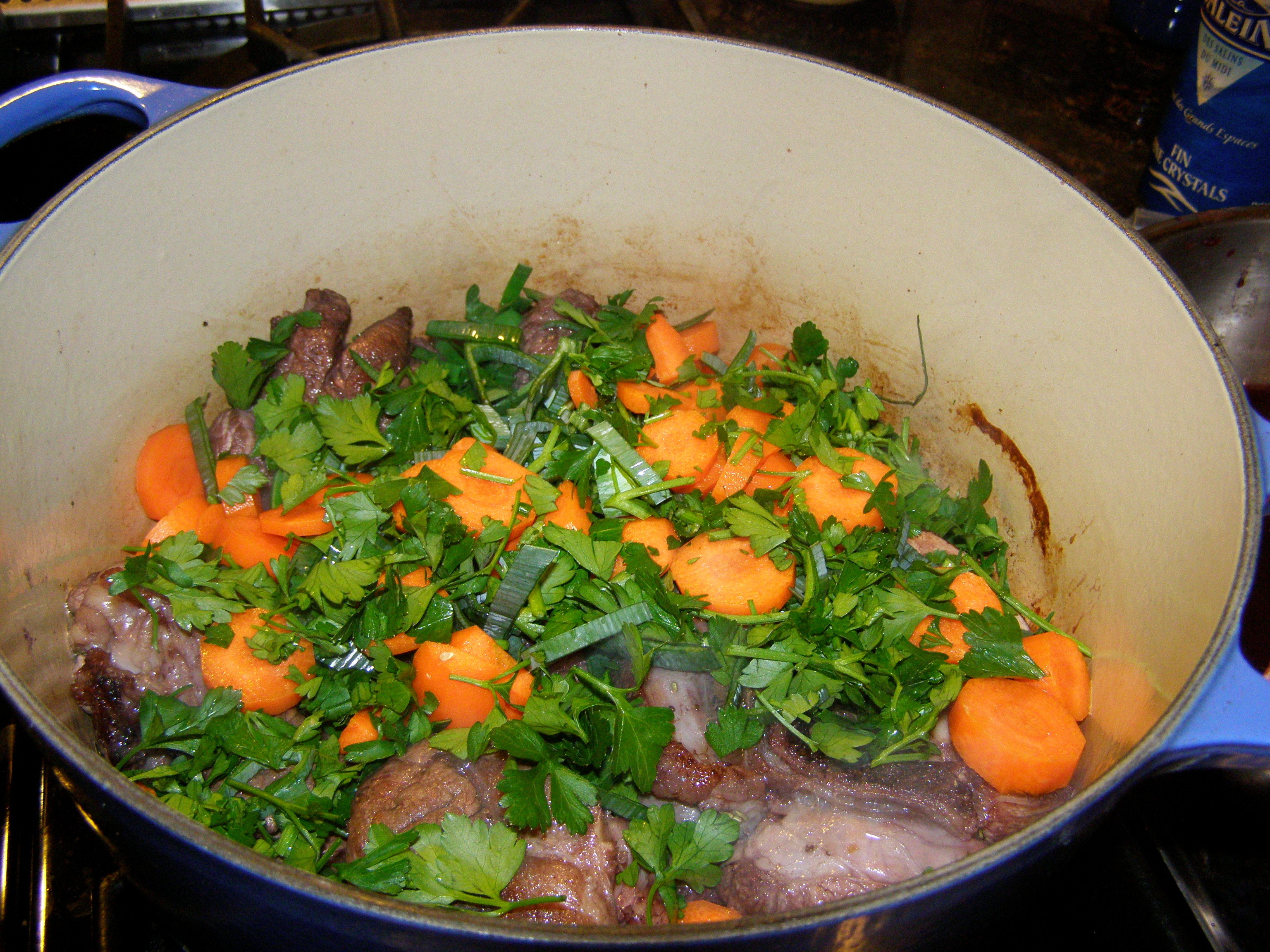
Buy beef shanks cut in thick slices with the bone attached. Marinate them in two cups of red wine, 1 tsp sugar, 1 clove garlic,  1/2 bay leaf, thyme, for one hour. Pat the meat dry, then brown the meat in a cocotte Le Creuset on high with olive oil. After 3 minutes on each side, add the marinade, 2 sliced carrots, 2 cloves garlic, 1/2 sliced onion, 2 pieces of orange peel, 1/4 cup chopped parsley, 1/2 cup finely chopped sliced leek greens,  1/4 tsp ground anise seeds, 1 tbsp sun-dried tomatoes, black olives, and the stalks of a fenel , chopped very fine. Add one cup of water,  salt and pepper, cover with the lid and cook in the oven for 2 hours at 325.


During the last 15 minutes of cooking add slices of potatoes in the cocotte on top of the meat. Also sauté the sliced fennel bulb and a green bell pepper and serve on the side. The marrow bones can be served on the plate, or you might want to empty them in the gravy. The fennel and spices added a  welcome summery taste to this winter dinner.


Posted in Main Course | Tagged , , , , , , , , , , | 6 Comments

Edamame, Avocado, Beet salad : satisfy your winter craving for greens

If you scroll down all the way to the bottom of this page, you will notice a new “calorie counter” in the bottom right corner. It is very neat as it will tell you not only calories, but also all the vitamins and minerals and fiber contents of almost any food.


The salad was made with 1 avocado, 1 cup of beets (cooked, peeled and sliced), 2 cups Edamame (cooked) and vinaigrette dressing with two chopped green onions.

To illustrate, I punched in the ingredients of this salad  for two and for fun you can calculate that  it has 280 calories per person (without dressing),  48% of your recommended daily fiber and 18% of your iron .

Calories in California Avocado

California Avocado
Nutrition Facts

1 fruit, without skin and seed (136g ≈ 0.300lb ≈ 4.80oz)

Calories 227
From Fat 189
% Daily Value*
Total Fat 20.96 g 32%
Saturated Fat 2.88 g 14%
Trans Fat ~
Cholesterol 0 mg 0%
Sodium 10.88 mg 0%
Total carbohydrate 11.75 g 4%
Dietary Fiber 9.25 g 37%
Sugars 0.41 g
Protein 2.67 g
Vitamin A
4%
Vitamin C
20%
Calcium
2%
Iron
5%
* Percent Daily Values are based on a 2,000 calorie diet. Your daily values may be higher or lower depending on your calorie needs.
Calories in Edamame, frozen, unprepared
Edamame, frozen, unprepared
Nutrition Facts

1 cup (118g ≈ 0.260lb ≈ 4.16oz)

Calories 130
From Fat 50
% Daily Value*
Total Fat 5.58 g 9%
Saturated Fat ~~
Trans Fat ~
Cholesterol ~~
Sodium 7.08 mg 0%
Total carbohydrate 10.12 g 3%
Dietary Fiber 5.66 g 23%
Sugars 2.93 g
Protein 12.10 g
Vitamin A
~
Vitamin C
19%
Calcium
7%
Iron
14%
Calories in Beet
Beets, cooked, boiled, drained, sliced…
Nutrition Facts
Serving Size 85g ≈ 0.187lb ≈ 3.00oz

0.5 cup slices (85g ≈ 0.187lb ≈ 3.00oz)

Calories 37
From Fat 1
% Daily Value*
Total Fat 0.15 g 0%
Saturated Fat 17 mg 0%
Trans Fat ~
Cholesterol 0 mg 0%
Sodium 65.45 mg 3%
Total carbohydrate 8.47 g 3%
Dietary Fiber 1.70 g  7%
Sugars 6.77 g
Protein 1.43 g
Vitamin A
1%
Vitamin C
5%
Calcium
1%
Iron
4%


Posted in Starter, Vegetables, Vegetarian | Tagged , , , , , , , , | 4 Comments

Sable fish and Scallops on hazelnut pesto with sepia ink rotini and fresh hedgehogs

It is not heart shaped nor red but I think that plate could make a very successful Valentine’s day dinner if you are lucky enough to celebrate. Fresh sable fish, sometimes called black cod, has just arrived to Vancouver Island and it is a great treat, nothing to do with cod. Its flakes are moist and tender, far superior to the halibut’s, and its flavour is one of the best in the Pacific ocean.


The pesto is made in the food processor with 1/4 cup parsley, 1/4 cup cilantro, 1/2 cup cooked spinach, 1/2 cup fresh organic  BC hazelnuts, 1/4 cup cider vinegar, 1/2 cup cream, 1/2 cup water. It is heated up on low.

The pasta is black as it is dyed naturally with cuttlefish ink  also called sepia. It is just cooked al dente in abundant salted water.

The hedgehogs mushrooms were picked near Victoria  between snow patches in the woods and they are sauteed in butter with a diced clove  of garlic added towards the end.

The sable fish  and scallops were cooked in a frying pan with olive oil on high for a short time. The fish skin is very  crispy and delicious once browned so leave it on for sure.

Serve with Champagne, of course!

Posted in Main Course | Tagged , , , , , , , , | 4 Comments

Quiche with spinach

There is a good idea for a quickly prepared impromptu lunch. Pretty much your regular “quiche lorraine” recipe with added spinach. We had that today with a fresh beet salad on the side. It was  a perfect winter lunch.


For one pie crust, I cooked 4 slices of bacon cut in small bits in a frying pan with four sliced white mushrooms and a quarter of a chopped large onion for about 5 minutes. This I mixed with 5 eggs beaten with 1/4 cup cream (or homo milk). I added one package of frozen spinach ( about the equivalent of a fresh bunch) salt and pepper. Mix well, pour into the pie shell, add small slices of cheese on top,  raclette  cheese today. Bake at 350 for 40 minutes. Turn off and serve 5 minutes later. I served it with sliced beets sprinkled with balsamic vinegar and truffle oil.


Posted in Lunch, Starter | Tagged , , | 3 Comments

Roasted Yams à la Canadienne

You might think that yams are sweet enough, but… if you are Canadian or leave in Canada and have to go through the Canadian winter, you might think that you can’t get enough calories from  vegetables alone to keep you warm. Besides, it is likely better for you to have a treat of roasted yams  brushed with maple syrup than almost anything you buy already made. The yams are bright orange when they are cooked and certainly, as far as I am concerned, they rival with any candy.

It is best to plan the yams for a day when your oven will be on for a while at a medium temperature. First thing to do is to peel them, which is easy enough with a Y-shaped peeler. Do this just before cooking them so they do not discolour. Rub the bottom of a dish with the two halves of a garlic clove, then spread either butter, goose or duck fat, or olive oil (or any combination of these). Cut the yams in thick slices or long sticks and rub them in the fat, then turn them over. Sprinkle thyme, oregano and start roasting around 325. Sage is also a good choice  and would go well with a pork roast. Turn the yams over a couple time while they cook. When the yams are tender (30 minutes or more depending on the size), paint them with 100% pure Canadian maple syrup, just a light coating, and finish in the oven for another five minutes. Add salt and pepper before serving.

Note: It is best to warm up the syrup  a little bit as it will spread more easily on the yams, especially if it is kept in the fridge.

Posted in Vegetables | Tagged , , , , , , | 2 Comments

Green Bell Peppers stuffed with Fava bean Tahini

It all started at For Good Measure, my local bulk store and a great place. I bought two cups of dried fava bean, because of a sudden craving for bean salad. I was very careful with the fava beans  as they should look their best for a salad, but things went terribly wrong as I cooked them. Maybe because of the altitude (I was up island at Mt Washington) the beans turned almost immediately mushy when I started cooking them. Small disaster as we had lots of other items on the menu that night. I was left with about two cups of fava puree, not such a bad thing it turned out.


Puree two cups of cooked fava beans with 3 tbsps Balsamic, 2 tbsps olive oil, 1/4 cup chopped cilantro, 1/4 tsp seasoning salt, the juice of half a lemon,  3 crushed cloves of garlic, salt and pepper. Cut the top of the peppers, remove the seed and any white parts.  It would be best to pick  round-shape peppers as my long and narrow ones had a tendency to topple over that I could not control. Fill the peppers with the spread, cover with the tops and roast at 325/350  for 30 minutes. Although very nourishing, the fava bean is a very fluffy and light stuffing.


If you are using canned beans, make sure to rinse them thoroughly. I was using dried beans. First, they have to be rinsed well and  soaked overnight in lots of water. Then, they need to be peeled and rinsed again. The beans that float should be thrown out. The beans are boiled gently in water for about 30 minutes and drained and rinsed again.

Dried fava beans peeled after soaking

“ Soaking dried beans activates the beans to begin the germination process. Once wet, the beans release enzymes that begin to break down their complex sugars into more simple ones. It is the bean’s complex sugars that give you gas and indigestion after eating beans that haven’t been pre-soaked. The overnight soak method reduces 60% of the complex sugars in most beans.”

“NO SALT When Cooking Dried Beans:
Add NO salt until the beans are tender and cooked completely. Adding salt will prevent the beans from absorbing water. This is because a bean has an opening that is large enough for water molecules to enter it, but salt molecules are larger and will plug the bean opening, preventing the water to enter… thus you have HARD beans that never seem to cook right. Some say the bean is TOUGH, but the scientific reality is that the bean only got to absorb the water you soaked it in and not the water you cooked it in.”

Above comments from : http://www.chezbettay.com/pages/basics1/basics_beans1.html

Posted in Vegetables, Vegetarian | Tagged , , , , , , , , , | 1 Comment

The best home-made comfort food is Lasagna!

Home-made lasagna is just enough work that you feel rewarded for serving a healthy home-made dish without  incurring too much trouble, especially with the ready to bake pasta now available at all grocery stores.  This is the point of this recipe, not too many pots, not a lot of fussing. ( 1 frying pan, 1 baking dish, 1 bowl).

First, the frying pan : Brown  half a kilo of lean ground beef with one chopped onion  or 5 green onions, and 3 tbsp olive oil, one tsp thyme, one tsp oregano for about 5 minutes.

The bowl: beat one egg with 1/2 cup cream, 1 tsp salt, pepper. Add one  400 gr. tub of Ricotta cheese, one package of frozen chopped spinach thawed but not drained, one chopped yellow pepper, 12 black olives pitted and cut in quarters, 1/4 cup chopped parsley,  2 crushed garlic cloves, 1 can of tomato paste,  1/2 cup water, one cup of grated Mozzarella, the content of the frying pan.

The baking dish: rub two tbsps olive oil on the bottom, add a layer from  the bowl (1/4 of the content), cover with the lasagna sheets, (cut and paste to fit the dish). And so on until you have four layers of pasta. Cover with one can of  crushed tomatoes (398ml) and 1/2 cup grated parmesan cheese.

Bake for 45 minutes at 350 uncovered.  After 35 minutes, if necessary, adjust oven temperature and amount of liquid to obtain a moist dish with a nicely brown topping.  When achieved, stop the oven and let rest on the rack for 10 minutes. Serve with green salad and garlic bread!


Today, I used fresh spinach, one large bunch blanched and chopped, two inches cut off the stems. ( I know, one more pot to rinse!) And I had some Raclette cheese that I cut up in strips to decorate the top layer. That was very tasty. Serves 4 to 6.


Posted in Main Course | Tagged , , , , , , | 2 Comments

Red Swiss chard, a Vitamin K trove.

This is a really nutritious green vegetable and unlike kale, rapini and collard green, it is tender, exquisite and quick to prepare. The green is not really Swiss, it was just called that originally to distinguish it from French Spinach. Not a very good explanation as chard, actually a member of the beet family,  grows well in all Mediterranean countries. The fact that chard belongs to the beet family, a root vegetable, might explain why my grand-mother would cook only the  white stems and give the greens to the chicken. I certainly would not do that, mind you I don’t have chickens.


The chard I buy at the Root Cellar is , although very fresh, quite mature and the stems are a bit hard. I therefore  separate the greens, and cut the stems (especially the red ones) in 2 inch pieces to boil about 5 minutes in a little salt water. When the water has evaporated, I add two crushed cloves of garlic and a good size chunk of butter and sauté this with the greens for another 7-10 minutes. Don’t overcook!  No need to add anything else, the flavour is delicate but perfect without other spices. Tonight I served this with a roast chicken, left-over gratin dauphinois and sauteed Hedgehog mushrooms  we picked yesterday (yes Jan 15th) in between snow patches in woods close to Victoria.


Posted in Vegetables, Vegetarian | Tagged , , , , , | 4 Comments

Quick chicken thighs en cocotte

I just don’t feel much like eating these days, don’t feel like cooking. There has just been too many good meals, too many “French” (5 courses) menus, way too many cookies, chocolates and other treats. It felt somehow expected and appropriate to serve all this during the holidays but now a healthier, simpler fare is back on the table. January being the month of good resolution, I am back to “la cuisine des familles”, mostly dishes that can be put together in half an hour or so and that require few ingredients.


Last night was a treat! All ready on the table in 30 minutes. I skinned four large chicken thighs and started browning them on high in a Le Creuset cocotte with one clove garlic and 2 tbsp duck fat (olive oil is a good substitute). I turned them over and added a chopped onion, two sliced Yukon Gold potatoes, thyme and parsley, 2 leeks halved and a cup of white wine (left-over and kept in the fridge). I simmered that with a lid on for 25 minutes. There was just enough sauce at the bottom of the pot to moisten the chicken and the potatoes when I served. You could have also thrown in olives and mushrooms. The chicken thighs are better than breast meat as they remain very moist and tasty from cooking with the bone in. The white wine is just an option to finish open bottles, but chicken broth is just as good, or a mixture of water and lemon juice.


Posted in Main Course | Tagged , , | 1 Comment

Too rainy to BBQ ? Bake the salmon!

The weather has been damp and grim, too cold and wet to step outside to the BBQ. Most of my friends are in Mexico or Hawaii escaping the local desolation of our rain forest climate. I had this beautiful Spring (also called King or Chinook) salmon and filetted it. But then, no one would get their rubber boots and umbrella to cook outside in the darkness. Rainy day cooking is every day cooking in BC this time of year. Better adapt.


About 30 minutes before cooking, I greased a large Le Creuset enameled cast iron oven roaster with olive oil, added the two filets skin down and brushed them with two tbsps Dijon mustard each. Before putting the dish in the oven set at 330, I added thyme, salt and pepper, and 1/2 cup of pure Canadian Maple syrup. The cooking time was about 20 minutes. ( no turning over). The salmon is ready as soon as the flesh turns from translucent to almost opaque. Best not to overcook as the fish will dry instantly. Served “rare” the filets are moist and melt in the mouth. You may sprinkle them with cilantro or chopped green onions before serving and another option is to deglaze the dish with 1/2 cup dry white wine.

Posted in Main Course | Tagged , , , , , , | Leave a comment

Delectable Victorian New Year’s Eve Menu

Pictures only!

Candy Cane beets with vinaigrette

Spot Prawns from Critters Cove Marina Nootka Sound

Fanny Bay Oyster Fritters

Roasted Goose

GingerBread cookies by Caolyn P.

Ginger Bread cookies by Artist baker Carolyn P.

Chocolate truffles


Fresh dates filled with cream cheese by Laurence


Posted in Stuff | 1 Comment

Fanny Bay Oyster Fritters, a New Year’s day appetizer for Kings

This is a Lucy and the Frog… I executed Lucy Waverman’s recipe (pasted below)  from the Globe and Mail to the letter. It was easy, clear and incredibly good! My choice was the local  Fanny Bay oysters from Vancouver Island, as we get them so fresh!


Ingredients

12 large oysters, shucked

2 tablespoons butter

½ cup finely chopped shallots

½ cup finely chopped celery

1 teaspoon chopped garlic

½ cup all-purpose flour

2 tablespoons cornstarch

½ teaspoon baking powder

½ teaspoon kosher salt

Freshly ground pepper to taste

1 egg, beaten

1/3 cup cold water

2 tablespoons finely chopped parsley

½ cup vegetable oil for frying

Method

Drain oysters in a strainer for a few minutes. Coarsely chop and return to strainer until ready to use.

Heat butter in a skillet over medium heat. Add shallots and celery and sauté for 2 minutes or until softened. Add garlic and cook for 1 minute. Let cool.

Sift together flour, cornstarch, baking powder and salt in a large bowl. Stir in pepper. Make a well in the centre and drop the egg and water into the well. Slowly stir into flour mixture. Stir in shallot mixture and parsley. Stir in oysters.

Heat ½-inch oil in a heavy-bottomed skillet over medium-high heat until a cube of bread turns brown in 15 seconds.

Drop batter into oil, 2 tablespoons at a time, and cook fritters until golden brown, turning once, about 1 minute per side. Drain and serve immediately. Makes 10 to 12.


Posted in Appetizer, Starter | Tagged , , , , , , , | 4 Comments

Victorian New Year’s eve dinner: the Goose

Not because I live in Victoria, although… The idea came from Eat Magazine and their picture  with the caption ” Pander the Gander”.  The  brine and stuffing are almost exactly the recipe from Lucy Waverman’s column, “A Dickens of a Dinner, a Victorian Holiday Feast” (Globe and Mail Dec 8, 2010). The technique is from the December issue of Cooks Magazine for the glazed turkey. My Goose grew up in the Fraser valley and travelled to Slater’s, the butcher, on Dec. 22.

Victorian Goose with prune stuffing, chanterelles and baked apples

So  I picked up Mimi the Goose, all  10 and 1/4 pounds of her, wet and naked, at Slater’s on Wednesday and thought she could use a couple days off to recover from the ride with BC Ferries. In fact, the poor thing was so shaken that on Friday, I decided that she needed a day at the spa and a perfume bath, aka the brine.  I put her in my cherished Le Creuset  blue tub with  3 liters of  cold water mixed  with a brine made of 1 l of water (= 4 cups), 1/2 cup sugar, 1 cup kosher salt, the rind of 1/4 orange, 1 tbsp cracked peppercorns, boiled 2 minutes. There were no bubbles, but it was all natural! Mimi liked it so much she soaked in there overnight despite being outside on the cold patio. I let her sleep in Friday morning, then patted the poor dear dry, rubbed her with a kind of talcum powder combining 3 tsp baking powder, 2 tsp salt, 1 tsp ground pepper and let her air dry some more on a rack so that her skin would take a better tan later. Then, I inserted two cloves garlic, two smoked sausages, a mandarin peel, thyme, in her chest cavity, closed her off and pushed slices of black truffle under her skin. I also nicked her all over with the tip of a knife so her fat would drain out during her visit to the tanning salon. The thermostat was at 33o for an hour and 3/4, a slow start. Then 30 minutes rest while I drained the fat into a glass jar.

Le Creuset Stock pot used as Hot-tub, or rather cold bath.

During the next 30 minutes of cooking the heat was higher, about 360, and she required frequent applications of tanning lotion, at least 3 or 4 times. This glaze was made by reducing 1/2 cup molasses, 1 cup red wine, 2 tbsp balsamic, 1/2 can cranberry sauce, 2 tbsp Cognac,  a small chunk of butter, salt and pepper for 20 minutes. This glaze created a perfectly crisp brown skin. I served the goose with potatoes, yams, chanterelles, baked unsweetened apples (the tartness is nice to counterbalance fat), gravy and prune stuffing.

For the gravy, pour all the fat from the roasting pan into jars to save. Add a cup of water to the pan to deglaze, add whatever is left from the glazing mix and stir. You should not have to add flour.

For the stuffing, sauté 1+ 1/2 cups chopped celery, 5 sliced green onions, 2 cloves garlic, in olive oil for 10 minutes. Add thyme, sage, 1/2 cup chopped parsley, 1 tsp soya sauce, 2 tbsp Cognac, 12 chopped prunes, 1 cup white wine, salt and pepper. Bring to a boil, add one cup crushed croutons and stir. This is more stuffing than can fit inside the bird, so it is more practical to serve  on the side.

The goose was tender, moist,  gamy and very tasty. No one ever wants to have turkey again! The 10 pounder was plenty for six large servings, just enough left-overs for the next lunch, a nice jug of broth from cooking the bones, and of course the precious goose fat.


Posted in Main Course | Tagged , , , , , , , | 2 Comments

Parisian salted butter caramel macaroons

In Paris, they are the rage of the century. Macaroons of all flavours and colours are flying of the shelves of the best Parisian bakeries and there are no limits to the combinations. When I was a kid, a macaroon was more like a regular-shaped  cookie of Italian origin and made from an almond meringue. What the French refer to when they ask for “macaron” is now a sandwich cookie with two layers of meringue and a filling of ganache, mousse, cream or caramel, a super deluxe Oreo cookie, that melts in your mouth, a divine moment created by giving in to the temptation of eating basically pure butter and sugar!

This recipe was made from notes from Pavillon Elysée passed on to me by the Food Fluffer, my friend Anita, and is not that straightforward. My first attempt tastes pretty good but the presentation needs improvement. ( A project for quiet January). Part of the mystery is the language, the main ingredient is “tant pour tant” which means equal quantities, in this case, icing sugar and raw almond powder. They suggest that you go buy that, but it is easy enough to grind in the food processor, just make it very fine. So here we go for the outer layers ( about 4 dozens). Mix  500 gr of “tant pour tant” (  1+1/4 cup icing sugar and 1+3/4 cup whole raw almonds, then crushed to powder). Add another 7/8 cup of icing sugar, and mix gently with 2/3 cup+1 tbsp beaten egg whites with 2 tbsp sugar added at the end. (about 5 large egg white). Add brown or red food coloring. They said a few drops, but it looks more like a tsp is what it takes. Shape the cookies with a piping bag on parchment paper and bake at 340 for 10 minutes.
The filling is done in two steps. First a custard: Boil 1/3 cup milk with 3 tbsp sugar and a tsp vanilla extract. Mix 3 egg yolks with 3 tbsp sugar. Drizzle the milk in  the eggs. Whisk on very low heat and add the soften butter ( 7/8 cup).  Second: the caramel, melt 1/2 cup sugar to a golden brown color, stop with  1/3 cup luke-warm  cream, add 2 tbsp salted butter and 1/2 tsp salt. Mix the custard with the caramel, cool, and spread on the macaroons.

Egg whites with colouring on top of Tant pour Tant

It is easier to keep the macaroons small, mine were too big. My filling was a bit too liquid so I added 2 tbsp tapioca flour to thicken it. Caramel will not work if the pot is not spotless, adding  a tbsp lemon juice to the sugar helps. All in all, this is quite a production, a fantastic Christmas treat especially for those of us not spending it in Paris! a small treat from France.

After much trial and error with this recipe I have to conclude that it is not reliable. Of course, we kind of managed to eat all the macaroons but they don’t look great and are just not quite right. I feel a bit burned out right now, the damp weather does not help either, so maybe someone  away from the rainforest here could try the recipe from Lucy Waverman published in the LCBO Magazine in 2006, and let me know how it works. I am sure it is a good one!

Posted in Baking | Tagged , , , , , , , , | Leave a comment

Good old Times Butter Tarts from home-made Lard

When it comes to baking, Sharon is a perfectionist. And that is our luck because she has allowed me to share her recipes for the best butter tarts I have ever had. I say recipes, because we are not talking about the average pastry and filling combo here. Rather, this is a voyage back in time and tradition, from rendering the pig fat to produce lard to making the flakiest dough and a filling to die for.

I guess it all started when Sharon bought half a pig from a farmer she could trust. Piggy or should I say his better half arrived in Victoria with all the trimmings, some that no one was too sure what to make of, including a package of fat. Eat Magazine came to the rescue with an informative article about rendering pig fat and how to make leaf lard. That was the lucky break and the excuse to eat the fat!

Sharon's butter tarts with home-made lard pastry

Step 1: How do your render lard? ( excerpts from Eat Magazine Jan 2010) Making lard is not difficult. Rendering is the process of separating and clarifying the pure lard from the fatty  connective tissue of pork fat. You simply chop up some pork fat, (preferably from the leaf or the back) place it in a pot with a cup or two of water and slowly heat it up. By the time the water has evaporated, enough of the lard has started to render out that the remaining solid fat can slowly poach and render at low heat without risk of burning. Let it bubble gently until you have a big pot of melted fat. Strain this and let cool. Portion and store in the fridge or freezer.


Step 2: Pie pastry with home-made lard , excerpts from Eat Magazine Jan 2010 . 2 cups flour, 1T. sugar, 1tsp salt, ¾cup cold unsalted butter cut into small cubes, ½ cup cold lard cut into small cubes, 6-­‐8T. cold water, or mix of half water and half vodka. Measure and sift flour with sugar and salt. Cut butter and lard into the flour mixture until you have flour coated fat pieces that range in size from corn meal to small peas–with more smaller pieces than large pieces. Slowly sprinkle in cold water, 1T. at a time, using a fork to mix the dough. Stop after you have added 6T. of water, no matter what the dough looks like. Turn dough out on to the counter. The dough will be very dry and crumbly at this point. Use your hands to gently gather the dough into a ball using gentle pressure to make it hold together. If the dough is still too dry, sprinkle on  1T. more of water and mix the dough with hands again until you can form it into a ball. In rare cases you will need to add the final tablespoon of water.(If using vodka and water mix, you can be more cavalier about adding liquid because the alcohol in vodka won’t form gluten. Gluten is what will make the pie crust tough.) Divide dough in two and form into disks. This dough can be used right away or  wrapped and refrigerated for a few days or frozen until you need it.

Step 3: Butter tart filling recipe adapted by Sharon from her family’s old recipe books.  ¼ cup melted butter, 1 cup brown sugar, 1 egg, ¾ cup currants or raisins or pecans, (I always use currants), touch of vanilla and salt. Melt butter, mix in sugar, egg, vanilla and salt until well blended. Add currants and mix. Spoon into unbaked tart shells– about 2/3 to ¾ full. Bake at 450°F for 8 minutes and 6-­‐8 minutes longer at 350°F. Let cool for 5 minutes or so and then remove from muffin/tart pans and cool on rack. Makes enough for 6 to 8 regular muffin tin size tarts or 8-­‐12 small tarts.

Final comment by Sharon: I think I am going to try this recipe again with less butter, e.g. 1/2 cup butter and 1/2 cup homemade lard to see how it works because I found it quite rich and think the pastry will still hold together with a bit less butter.

Chef Heidi Fink on lard: (excerpt from eat Magazine Jan 2010). Lard is better for you than shortening and better for cooking than vegetable oil. It is a whole food, a naturally saturated fat that is stable at high temperatures and won’t burn into trans-fats as it heats. Lard ( at 40%) is lower in saturated fats than butter 60 to 65 %, margarine 45%, and palm oil 80+%. Even better, most of the remaining fat in lard is made up of oleic acid, the very same kind of mono-unsaturated fat that makes olive oil so famously good for you. I am of course talking about home-made lard. I make my own lard so I can make the best pie crust! Shatteringly flaky.


Posted in Baking, Little help from my friends | Tagged , , , , , , | 2 Comments

The green vegetarian quiche

This  is a smooth quiche and it does turn out a nice green colour. All the ingredients can be stored in advance which is nice if you are renting a place which is far from grocery stores. This is also a good recipe to get rid of leftover salmon for those who have salmon instead of turkey for Christmas. I am having goose, but that’s  another story! My goose is fattening nicely in the Fraser Valley as we talk and will arrive fresh by BC Ferries Dec. 22 just on time for a nice bath (in brine not bubbles) before getting dressed up for Christmas Eve.


It has to be the easiest recipe ever.  For two quiches, just dump 7  large eggs, 15 artichoke hearts, one pack of frozen spinach, 1/4 cup cilantro (or 2 tbsp dry), one green onion (or 1 tbsp onion flakes), 1 large (15oz) can of salmon, 1/2 tsp seasoning salts in the food processor and puree. Transfer to a bowl, add salt and pepper and 2 cups grated cheese. Pour in the pie shells. Bake at 350 for 45 minutes. The taste is slightly tart. It is best served warm, but cold is not bad. For a more fluffy result, beat the egg whites separately before adding them last to the content of the bowl.

Posted in Lunch, Main Course, Vegetarian | Tagged , , , , , , , | 1 Comment

Tasty tender lamb stew in sauce

This stew is another one of my winter favorites, it is easy to make, the lamb meat is inexpensive and the sauce is not fat, but very tasty. For three people, I had three shoulder lamb shops and about as much weight in lamb necks, less meat but great bones for flavour. I started by sprinkling 2 tbsp garam masalam powder and 1/2 tsp thyme on the raw meat cut in small pieces leaving it on the counter while I chopped an onion and four tomatoes. I then browned everything together in 2 tbsp olive oil in a cocotte Le Creuset for a good 5 minutes. At this point, I added 1/2 glass white wine and 1/2 cup water, salt and pepper, 1/4 cup cilantro, 2 cloves garlic, covered with a lid and cooked on medium low for 25 minutes. Now, time to add sliced carrots, black kalamata olives and white mushrooms. Cook another 30/40  minutes, either covered or not depending on how much sauce you want. Serve with mashed potatoes and a dry white wine.


Posted in Main Course | Tagged , , , | 4 Comments

The ultimate chocolate truffle

Cocoa tree and bean

This is truly the chocolate lover’s ultimate treat, a dangerous little nugget, smooth inside, covered with a soft shell and dusted in powder,  all three elements containing chocolate. You try one, it tastes so good, you have to test another to identify all the flavours but it is impossible to stop, each one you thought would be your last, is better than the one before… so my advice is don’t double this recipe. It is enough for a batch of four dozens, plenty even if you have company and …a few samples for the chef, necessary for quality control.

You need 400 gr of the best dark chocolate you can find. I am bias to think that the French brands are ideal for cooking. Smoother than Baker’s or Caillebaut and more tasty. First,  mix two large high quality egg yolks with 5 tbsp icing sugar until the mixture is creamy. Second, melt 300 gr of the chocolate in a bain marie, then add 10 cl Armagnac or the liquor of your choice and keep warm. Third, bring to a boil 1/4 cup unsalted butter, 1/2 cup 30% cream, 5 tbsp icing sugar, 1 tsp instant coffee,  whisking constantly.  Pour this over the egg yolks  while stirring, then pour this over the chocolate stirring with a fork. When it is completely smooth,  refrigerate for about three hours.

Form small balls with two teaspoons or  with a pastry bag with a smooth tip. Put them on  wax paper on a tray or cookie sheet. Refrigerate again for one hour and get set up for the last stages. Melt the last 100 gr of chocolate in a large mug, add 1/4 cup warm water to it. Dip the truffles in the chocolate using prongs and return to the wax paper, the soft centre is now covered with a chocolate shell. Refrigerate 2 hours, then roll the truffles in the cocoa powder. Store in the fridge and eat quickly, no, not that quickly!


Posted in Baking, Dessert | Tagged , , , , , | 3 Comments

Pork tenderloin in mustard cream sauce minus the cream

The mustard sauce is perfect with the tenderloin as it keeps it really moist. Tenderloin being very lean would  tend to get dry easily, so  a short cooking time and a good sauce are required.

preparing to brown

I start by chopping about half a pink onion and cleaning some nugget potatoes. I start a large cocotte Le Creuset with 3 tbsp olive oil on medium high and brown all together the onion, the potatoes, and the whole tenderloin with sage and thyme. After 5 minutes, I deglaze with 1/4 cup cider vinegar, 1/4 cup dry white wine and 1/2 cup H2O. I add 1/4 cup chopped parsley, salt and pepper and cover on low for 30 minutes. Mushrooms and other vegetables like golden beets can also be included then.

Everything should be cooked within the half hour, I  remove it all from the cocotte, slice the meat and reserve it in a hot serving dish on the side, while I add 4 tbsp Dijon Mustard to the sauce, stir well and cook this for 5 minutes. If the remaining mixture is not enough, just add a bit of water, but I had just the right amount left. The mustard has to cook, as this will mellow its taste. The sauce will look like a cream sauce and will be a little tart but not like eating mustard.  Pour the sauce over the meat. Rice and mashed potatoes also go well with this. No need for cream, but of course, if you want to indulge, add 1/2 cup 30% cream and stir on low for another 5 minutes. Below, tonight’s dinner without cream!

Pork tenderloin with mustard sauce, potatoes, golden beet, mushroom and apple

Posted in Main Course | Tagged , , , , , , | Leave a comment

Hot Chili Peppers, get your BTU’s

The traveller’s guide to Mexico makes it all clear!

“The Scoville scale measures their (chili peppers) hotness in heat units (SHUs). Cayenne, the chili Tabasco sauce is made from, ranks a respectable 3rd place behind the hottest chili known to man, the habanero. The green Bell pepper is a 0! See how your favorites stack up.”

Chili                                           SHU

Habanero                                 100,000-350,000

Piquin                                          50,000-100,000

Cayenne                                       30,000-50,000

De Arbol                                       15,000-30,000

Chipotle                                                       15,000

Serrano                                          5,000-15,000

Jalapeno                                        5000-10,000

Pasilla                                              1,000-2,000

Poblano                                           1,000-1,500

dranzer says:

..just a correction, the hottest chilli according to  the Guinness Book of World Records is ‘Bhut Jolokia’ with an SHU of over 1 Million. Habanero comes second;)


Capsicum Annuum or Cayenne pepper named for the city of Cayenne in French Guiana


Posted in Stuff | Tagged , , , , , , , , | 2 Comments